Skip to content

Methodology

Discover. Diagnose. Strategize. Implement. Optimize.

A Strategic Methodology for Business Growth in the AI Age

Business growth rarely depends on one marketing tactic, one technology, or one platform. It depends on understanding what is really happening in the business, identifying the right opportunities, and bringing the right strategies, people, and technologies together around clearly defined goals. But you can't build the right strategy until you understand the business—what you're trying to accomplish, what's already working, what's getting in the way, and where the greatest opportunities exist.

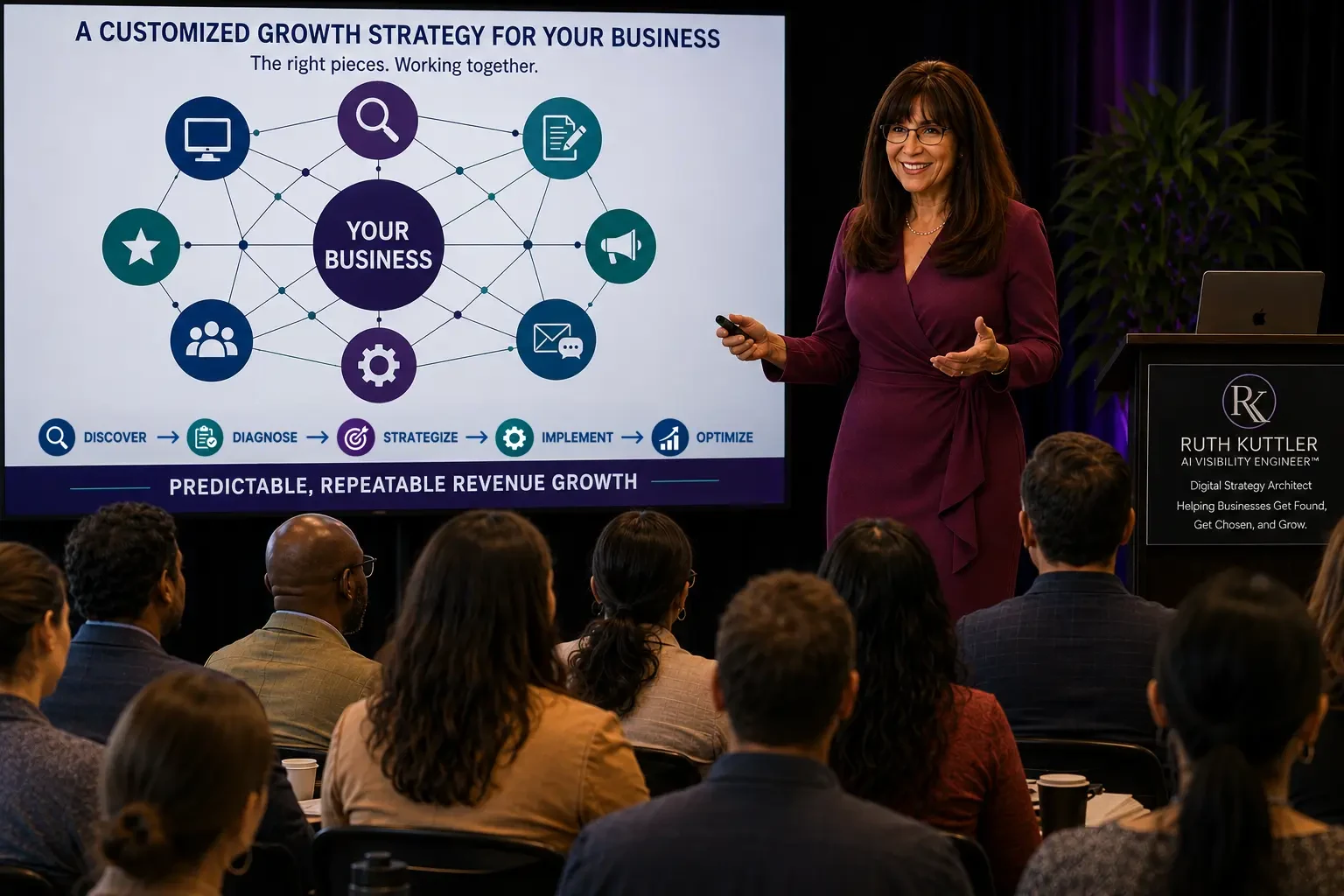
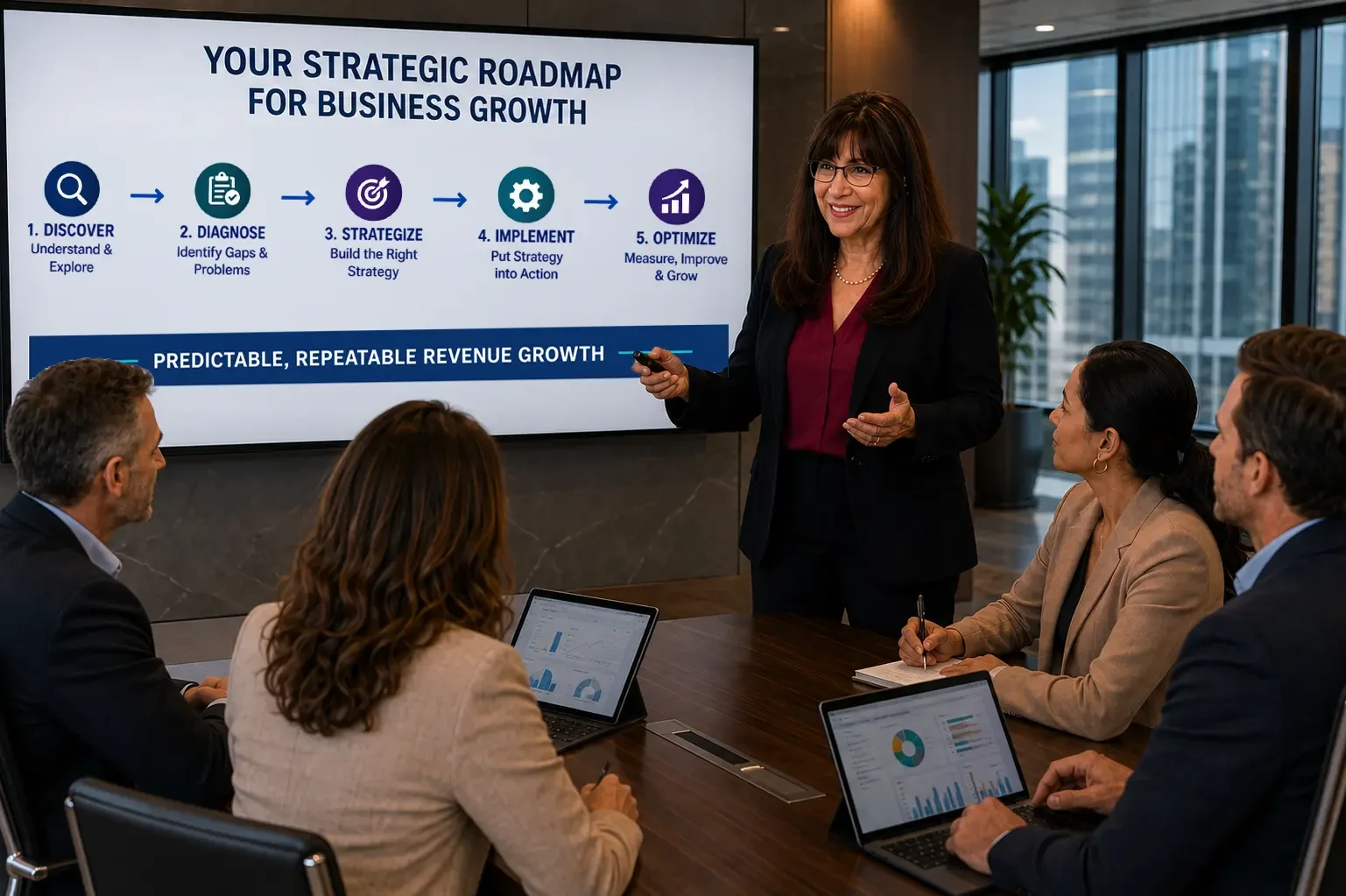
Ruth presenting the five-stage strategic roadmap for business growth

That's why I begin by understanding the business through a sequential methodology: Discover, Diagnose, Strategize, Implement, and Optimize. This strategic methodology for business growth provides the foundation for creating predictable, repeatable revenue growth—a game-changing approach in the age of AI.

Why and How This Methodology Works

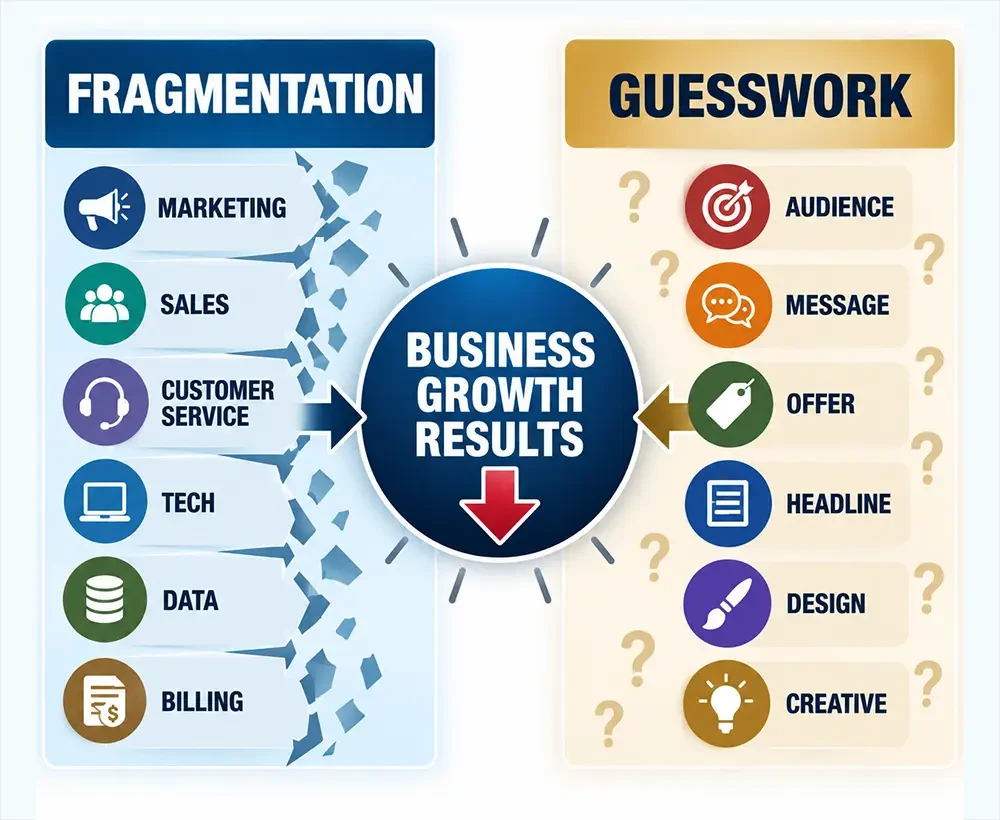
Over the years, I recognized two recurring problems that made business growth far more difficult, expensive, and unpredictable than it needed to be. One was fragmentation. The other was guesswork. Solving both problems became fundamental to the strategic methodology for business growth I use today.

Fragmentation and guesswork prevent coordinated business growth results.

Two Problems.

01 / Fragmentation

The Problem of Fragmentation

Businesses often operate or obtain marketing and technology services without an overall coordinated strategy. Different companies may handle websites, SEO, advertising, social media, CRM, and automation—with gaps in communication and little coordination between them. The same thing can happen inside companies, where marketing, sales, customer service, technology, operations, and billing may use different systems, data, messages, and priorities while failing to function interdependently.

Specialization isn't the problem; a lack of coordination, shared information, and common goals is.

02 / Guesswork

The Problem of Guesswork

Even when the appropriate marketing pieces are in place, critical decisions are often based on assumptions. Is it the right audience, message, offer, headline, design, or creative? Are you reaching ideal customers on the right platforms?

Is the right funnel in place to engage and convert prospects— and create additional opportunities with existing clients? The traditional answer was often trial and error: launch something, see what happened, and if it didn't work, try something else. That could be expensive, time-consuming, and risky.

What If There Were a Better Way?

The answer was to replace fragmentation and guesswork with a coordinated, evidence-driven process.

From Insight to Implementation

  1. Discover

    Understand the business.

  2. Diagnose

    Identify the problems and opportunities that matter most.

  3. Strategize

    Determine what should change and how the pieces should work together.

  4. Implement

    Put the strategy into action.

  5. Optimize

    Use data, testing, and measurable results to continually improve.

InsightStrategyReal Results

A Strategy Built Around What Your Business Actually Needs

My methodology isn't built around the services I provide. I select services based on what the business actually needs. Discover creates an understanding of the business. Diagnose identifies the problems and opportunities that matter most. Strategize determines what should change and how the pieces should work together. Implement puts that strategy into action. Optimize uses data, testing, and measurable results to improve performance continually. Together, the five stages create a coordinated process for replacing fragmentation with integration and guesswork with better information and evidence.

When AI Changed the Way Businesses Get Found

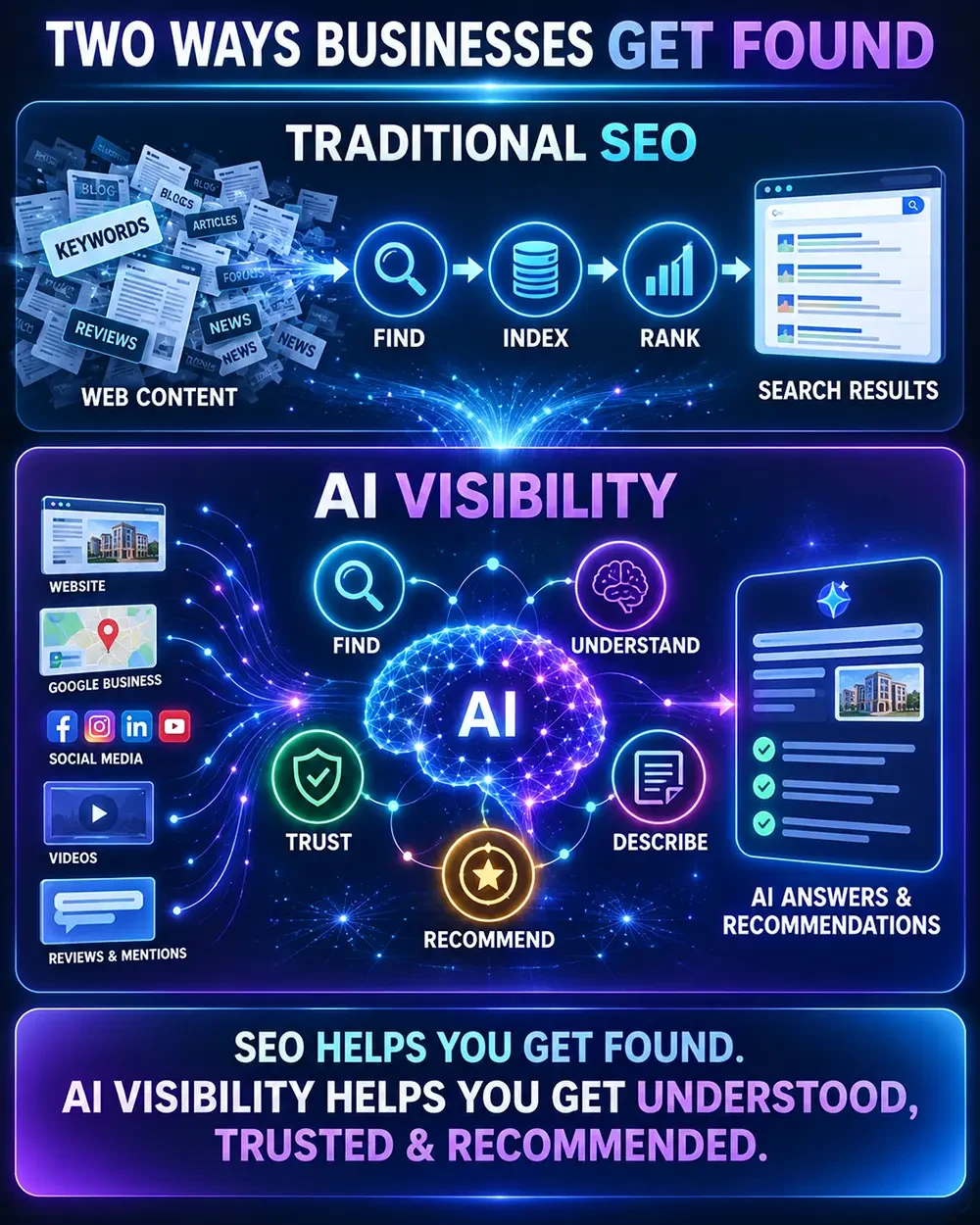
For years, helping businesses get found online largely meant search engine optimization. We learned how Google searched, indexed, and ranked information. We built websites and content to improve visibility in those results.

Then AI changed the equation. Search engines began integrating AI-generated answers directly into their results, often positioning them above traditional organic listings. People began asking AI systems the kinds of questions they once typed into a search engine—not simply looking for a list of websites, but asking questions, comparing options, and requesting recommendations.

That's when I realized we were dealing with two fundamentally different discovery environments. That realization motivated me to seek advanced education and mentoring in AI consulting and AI entrepreneurship. What I learned fundamentally changed how I thought about online visibility.

Traditional SEO helps businesses get found; AI visibility helps businesses get understood, trusted, and recommended.

Two Different Discovery Environments

While traditional SEO helps search engines find, index, and rank a business, AI visibility depends on AI systems finding, understanding, trusting, accurately describing, and recommending a business.

AI Visibility Has to Be Engineered

My training in AI consulting and AI entrepreneurship helped me recognize that this couldn't be solved by simply adding “AI” to traditional SEO. AI visibility had to be engineered. That realization changed how I viewed the disciplines I had spent years integrating.

While all remained part of an essential digital ecosystem, they functioned very differently for traditional SEO and AI visibility. Unlike keyword-driven SEO, AI visibility depends on a much broader range of signals that help AI systems understand who a business is, what it does, who it serves, and whether it can be trusted. Those signals must work together across the digital ecosystem.

Ruth working on an AI visibility project

AI Visibility Engineering™ — Building for People and AI

The digital ecosystem I had already been building for people now also needed to communicate clearly with machines.

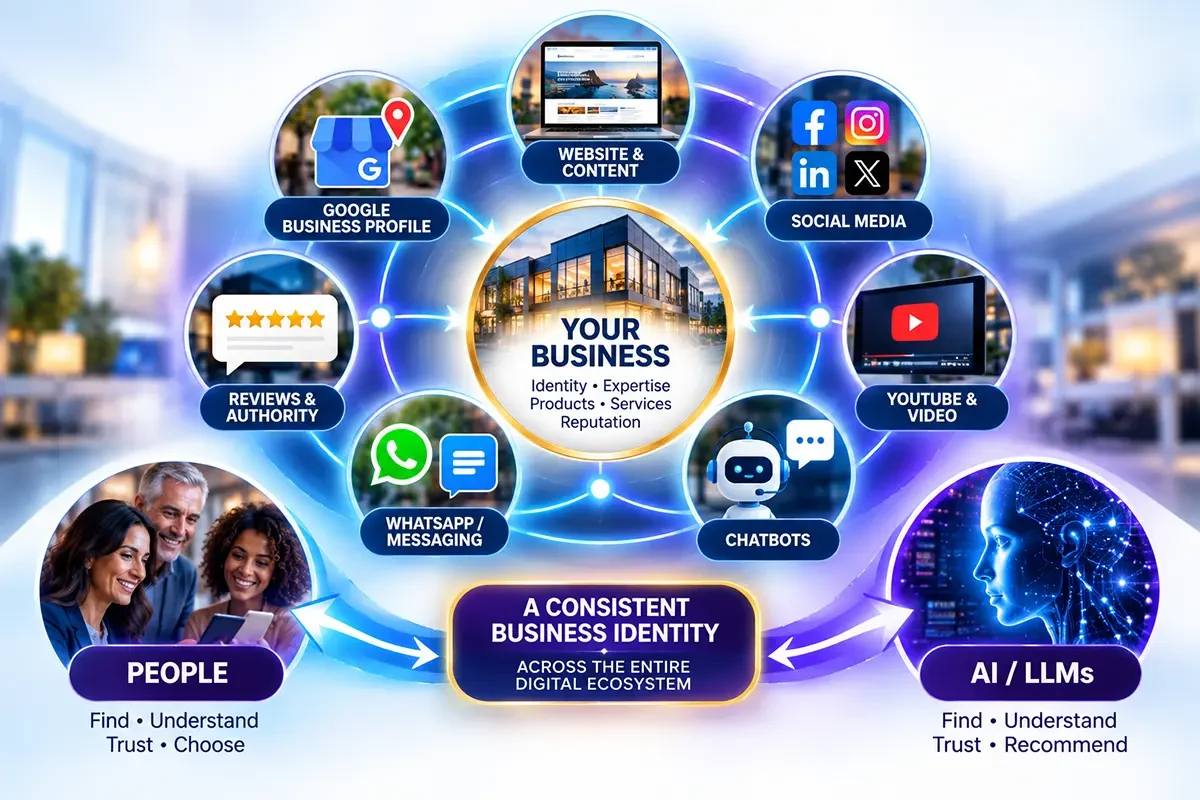
Communication for AI visibility does not happen in just one place. A business is represented across an entire digital ecosystem—from its website and content to Google Business Profile, social media, YouTube, chatbots, WhatsApp, and other platforms where it communicates its identity, expertise, products, services, and reputation. The goal is to make those signals clear, structured, and consistent so they reinforce the same business identity for both people and AI.

This is where my proprietary system, AI Visibility Engineering™, fits directly into the five-stage methodology. We discover how the business is currently represented, diagnose gaps and inconsistencies, develop a strategy to improve how people and AI understand the business, implement that strategy across the right platforms, and then test, analyze, and optimize the results.

The connected digital ecosystem communicates a consistent business identity to people and AI.

AI Visibility Isn’t Something You Add to a Website.

It’s something you engineer across the digital ecosystem.

Low-Risk Affordable Solution

Replacing Advertising Assumptions With Real Market Evidence

For years, a major problem I wanted to solve was the risk involved in advertising. Businesses could spend thousands of dollars on campaigns based on assumptions about the audience, message, offer, and creative—only to discover after the money was spent that one or more of those assumptions were wrong. Through advanced business training and mentoring, I discovered a proven, low-cost way to test before you invest—a strategy that produces predictable, repeatable growth.

Ruth working with a business team

The light bulb went on. This was what I had been looking for—an enterprise-level solution that could rapidly test multiple variables and replace assumptions with real market evidence, without the high costs traditionally associated with this level of testing.

Beyond Advertising: Where Micro-Testing Can Be Applied

As I learned more, I realized its potential went far beyond advertising. The same testing principles apply wherever you can validate important business or marketing decisions before making a larger commitment. This testing strategy can be used across marketing, advertising, websites, funnels, chatbots, and other applications to test variables and combinations before committing significant resources.

Addressing the Problem of Guesswork

Micro-testing directly addresses the problem of guesswork within my methodology. Rather than relying primarily on opinions or assumptions, testing provides real market evidence to inform strategy, guide implementation, and optimize what works.

Test. Learn. Build on What Works.

Instead of asking, “Which message do we like best?” we can increasingly ask, “Which message has the market demonstrated it responds to?”

One Methodology. One Business Objective.

Within this strategic methodology for business growth, AI Visibility Engineering™ helps the business communicate clearly with people and AI. Testing helps replace assumptions with evidence. Websites, content, SEO and AEO, CRM, automation, social media, video, advertising, and other technologies are selected and coordinated according to what the business actually needs. The objective is not to use more services or more technology. It is to make better decisions, coordinate the right pieces, and continually improve performance.

Clarity starts with the right questions

Frequently Asked Questions

What is AI Visibility Engineering™?

AI Visibility Engineering™ is my proprietary methodology for helping businesses become easier for AI systems to find, understand, trust, accurately describe, and recommend. It coordinates clear business knowledge and consistent digital signals across the platforms where people and AI encounter the business.

Is AI Visibility Engineering™ the same as SEO?

No. SEO remains an important component of digital visibility, but AI systems don't operate exactly like traditional search engines. AI Visibility Engineering™ takes a broader view of whether a business can be accurately understood and corroborated across its digital ecosystem.

Does traditional SEO still matter now that people are using AI?

Yes. Search engines remain an important source of discovery, and many fundamentals that make information understandable and authoritative also support AI visibility. The objective isn't to abandon SEO. It's to build upon it for a changing discovery environment.

How do websites, content, and social media affect AI visibility?

They contribute information and signals that help establish who a business is, what it does, who it serves, and whether it appears credible. The same principle extends across Google Business Profile, YouTube, chatbots, WhatsApp, and other digital touchpoints: the pieces need to communicate a clear, consistent business identity.

Why are CRM and automation part of the methodology?

Because visibility is only the beginning, CRM and automation help turn interest into relationships and opportunities through consistent follow-up, nurturing, and a better customer journey.

Do I need all of these marketing services and technologies?

No. That's exactly what this strategic methodology for business growth is designed to prevent. The process begins by understanding your business and identifying the problems and opportunities before determining which strategies, services, and technologies make sense.

Where does micro-testing fit into the methodology?

Micro-testing reduces guesswork by identifying which audiences are most responsive for a business and which combinations of messaging, offers, and creative motivate them to act. The results provide real market evidence to guide strategy, implementation and optimization across marketing and advertising platforms.

Where should I begin?

If you're unsure where your biggest opportunities or gaps are, start with the AI Readiness Assessment. It gives you a structured way to evaluate where your business stands before deciding what to do next.

Your next step

How Ready Is Your Business for the AI Era?

You don’t have to know which technology you need or diagnose the problems yourself. The assessment is designed to help uncover that.

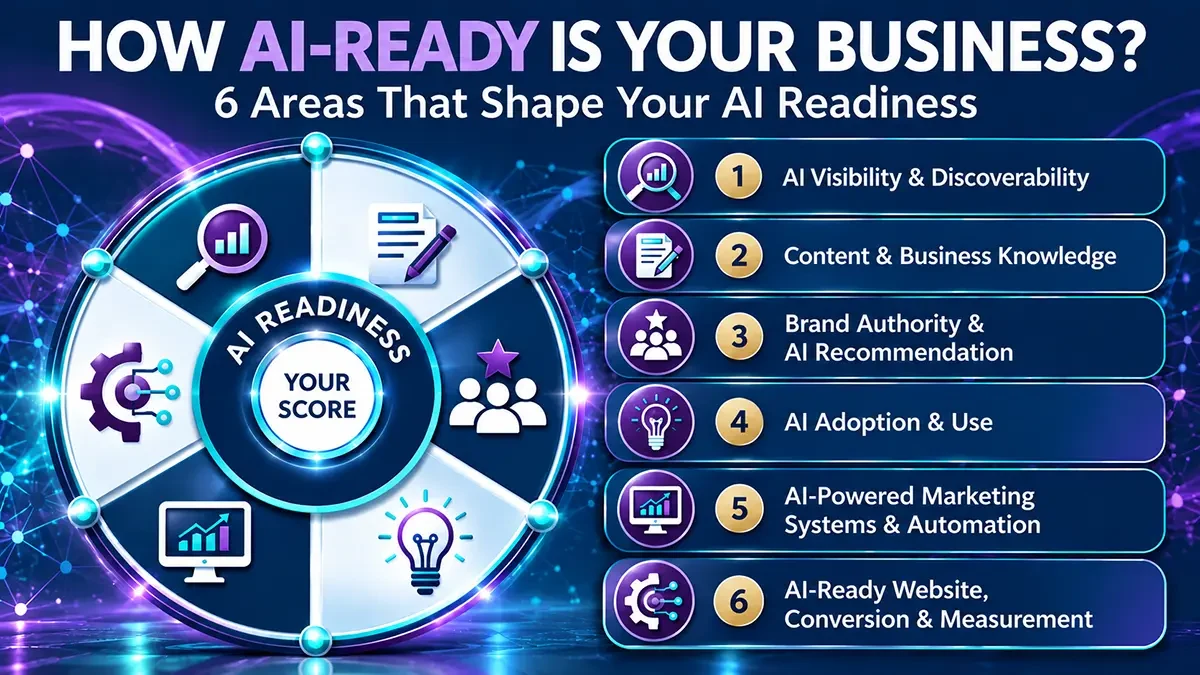
The AI Readiness Assessment evaluates six critical areas of your business and identifies where you are well positioned—and where there may be opportunities to strengthen your foundation.

Complete the assessment to receive your overall readiness score, category-level results, and recommendations for improving your AI visibility, marketing systems, and business growth.

Six AI readiness areas: visibility and discoverability, content and business knowledge, brand authority, AI adoption, marketing systems, and website conversion and measurement.