
Experience shapes perspective
How 25 Years in Healthcare Shaped Me as a Business Strategist and Technology Entrepreneur
If you had told me 25 years ago that I would build a career in technology, own a digital marketing agency, and develop strategies to help businesses navigate the age of AI, I would have told you it would never happen. For more than 25 years, my world revolved around healthcare. I worked as a nurse, nurse practitioner, educator, and healthcare leader. It may seem like an unlikely beginning for a business strategist and technology entrepreneur, but the way I learned to think during those years has shaped almost everything I've done since. The very same principles that guided me in healthcare became the foundation of how I approach business today.

Healthcare Taught Me to:
- Listen before assuming I knew the answer.
- Assess the whole situation rather than focus only on the most obvious symptom.
- Ask better questions and identify underlying problems.
- Explain complicated information in ways people could understand.
- Develop solutions around the individual rather than force everyone into the same prescribed approach.
The Profession Changed. My Purpose Never Did.
Now, instead of helping people navigate complex healthcare decisions, I help business owners navigate an increasingly complex world of strategy, marketing, technology, automation, and AI. I still begin the same way: understand the situation, identify what's really getting in the way, and determine the right path forward before recommending a solution.
Finding My Own Path
I was creative from my early childhood. I loved art, writing and working with children. I taught arts and crafts classes in my parents' basement, and when people asked what I wanted to be when I grew up, I wanted to be an artist.
But I grew up with a very different definition of success: get an education, find a secure job, and work hard. My mother had always wanted to be a nurse, and being the good daughter, I became the nurse my mother wanted to be. I invested seven years in higher education, became a certified family nurse practitioner, and spent more than 25 years in healthcare.
I had achieved what I had been taught to think of as success. I had succeeded at building a life that NEVER felt like my own. Eventually, that disconnect became impossible to ignore.
I was miserable. My experiences had caused me to question much of the medicine I was practicing, and my final position brought everything to a head. I was working for a doctor whose practices put patients at risk.
We had many disagreements; I knew my days there were numbered, and ultimately I was laid off. But losing the job wasn't the real crisis. For the first time, I was struggling with the prospect of doing this kind of work for another 20 years or more.
I still needed to earn a living, but healthcare was my education, my training, and my career. I had no idea what else I could do. What am I going to be now that I'm all grown up?
Going Not Where I Know
While going through the newspaper to look for another job, I kept coming back to a poetry contest. I didn't write poetry. I didn't even particularly like most poetry.
But I was a gifted writer, having received the top award for academic excellence in all 3 university degree programs I completed. So, after contemplating whether I should try my hand at writing a poem for that silly contest, I finally thought, why not? I decided to write about what I was feeling and see whether the process might help me understand what I was supposed to do with the rest of my career.
I called the poem “Going Not Where I Know.” What followed changed my entire life. For nearly three weeks, I wrote 12 to 14 hours a day as thoughts poured onto the page about following my heart, pursuing my dreams, taking risks, and refusing to allow fear, ridicule, or other people's expectations to determine my life. I had never learned these ideas from a book, teacher, or parent.
They contradicted much of what I had been taught about how a responsible person was supposed to live. I came to understand the experience as a connection to my higher self—and I began to trust it. For the first time, I was discovering who I wanted to be and already was.
That Spiritual Experience Gave Me a New Direction
That awakening led me to the Internet, where I saw an opportunity to express my creative self—to use my writing and artistic talents to help businesses grow. That became my mission.
Someone Who Believed in Me
Fortunately, someone stood beside me with unwavering belief in my ability to make the extraordinary transition from helping people with their health to helping businesses with their marketing. My husband, Paul Kuttler, encouraged me to explore and embrace my dreams. His confidence in me gave me the courage to take risks, go back to school, and pursue the potential I was finally beginning to recognize in myself.
He has since passed away, but his belief in me remains part of everything that followed.

Building a Business for a Changing World
Along the way, I discovered what drove me most was solving problems at the intersection of creativity, strategy, and technology. That vision defined my path to entrepreneurship and became the foundation for Webpuzzlemaster, a digital marketing agency founded in 2007. I returned to school because I knew the Internet would change the world—and I wanted to be part of it. I wanted to start my own company, build websites and help businesses use the Internet to grow.
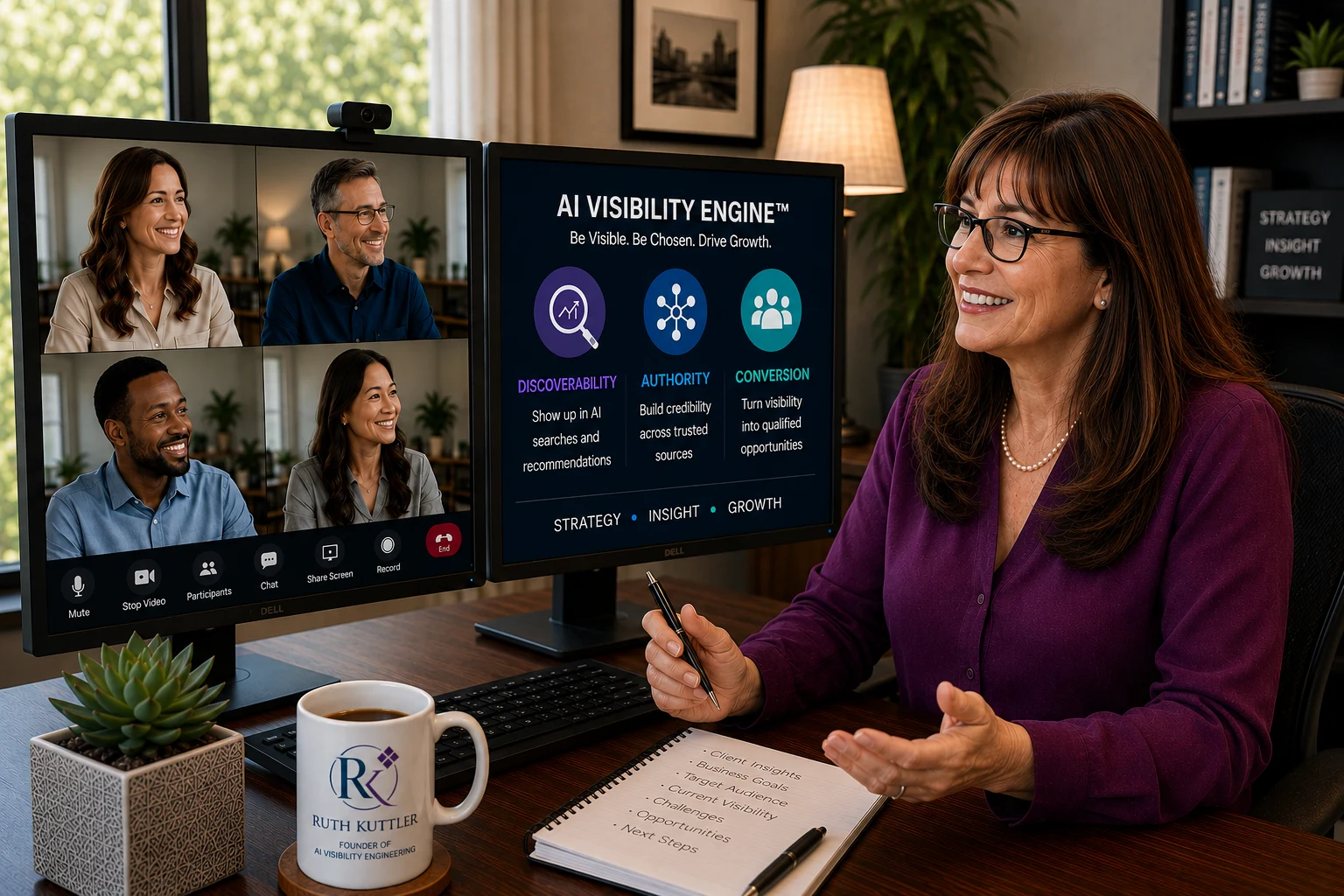
As the digital world evolved, so did my vision for my business. Mobile marketing, social media, YouTube, and Google were fundamentally changing how businesses reached and connected with customers. I followed the trends I knew would matter, continually learning how my clients—and my own business—could benefit from emerging technologies.
Seeing the whole picture
Validation Through an Early Client Experience
One of my early clients was a contractor outside Boston who contacted me about SEO services for his website. An analysis of his site revealed problems with content, strategy, and user experience. By asking questions, I learned what made him different and why people would choose him: his workmanship and customer service were outstanding.
Yet he was buying leads that were resold to several competitors. Whoever called first with the lowest price usually won the job. I asked whether attracting bargain hunters was really what he wanted.
He said it wasn't. I told him that if we rebuilt his website around who he actually was—his quality, his values, and what made him unique—we could attract customers who valued those things and help them understand why he was the best choice. Two days after the new website launched, he ranked first on Google.
But he thought nobody cared— and I wasn’t absolutely sure he was wrong. Then, a few months later, he called to tell me he no longer bought leads. People were calling already sold on doing business with him.
That call clarified what my work really was. It wasn't simply about building websites or improving search rankings. It validated my vision for what the Internet could do for businesses.
By understanding the business, seeing opportunities the owner couldn't yet see, and putting the right pieces together, I could help business owners change their outcomes.
As the Internet Evolved, So Did the Misinformation About Marketing
Soon, business owners were being bombarded with confusing messages from companies, each with an agenda to sell them a different marketing service. The result was often a fragmented collection of services with little coordination or communication between the people providing them. Branding and messaging became inconsistent across websites, social media, and other platforms.

Marketing goals weren't aligned. Websites failed to attract the right audiences, and even when they generated traffic, they often lacked the strategic funnels and conversion pathways needed to turn visitors into customers and deliver the promised ROI. I saw that businesses didn't need more disconnected marketing services.
They needed someone who could see how all the pieces fit together—my concept for Webpuzzlemaster. I also knew that two businesses in the same industry can have completely different problems. One may need greater visibility.
Another may already have traffic but fail to convert it. Another may have weak positioning, inconsistent messaging, poor follow-up, fragmented customer data, or inefficient operations. That is why I have never believed in one-size-fits-all solutions.
Success Begins by Understanding the Problem Before Proposing the Solution.
Two businesses in the same industry can have completely different problems.
Continuous Learning to Keep Pace With Rapidly Evolving Technology and AI
As a business strategist and technology entrepreneur, I know technology and AI evolve too rapidly to rely on yesterday's expertise. I invest in ongoing education and mentoring from proven experts who provide current information, strategic guidance, and access to emerging tools and technologies. Over the years, I've developed hands-on knowledge across every aspect of my business—from server security and website development to AI visibility and SEO, CRM and automation, social media, email and SMS marketing, online advertising, strategic planning, content development, analysis, and testing.

A Unified Team Approach to Understanding You and Your Business Needs
Every business has different goals, challenges, opportunities, customers, and resources. As a business strategist and technology entrepreneur, I don't begin with a predetermined solution. I begin by understanding your business, what you're trying to accomplish, and what's standing in your way.

From there, I lead and coordinate a team of trusted specialists selected for their expertise and the needs of our business clients. Under my direction, the team follows a unified strategy based on the needs, goals, and priorities identified and mutually agreed upon with each client.
Let’s Start With a Conversation.
If you're ready to replace guesswork with greater clarity and make more confident decisions about where to invest your time, money, and resources, let's start with a conversation. Answer a few quick questions about your business so we can make the most of our time together.
Start with a strategy consultation